Meet Demis Hassabis: The genius behind Gemini

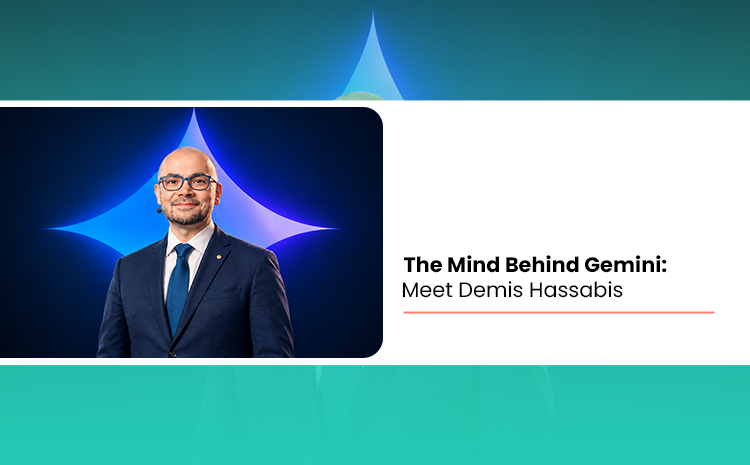
You use Gemini daily, but do you know the person who built it brick by brick?
He is Demis Hassabis, Co-founder & CEO of Google DeepMind.
Demis is many things: a computer scientist, AI researcher, entrepreneur, neuroscientist and a former game developer. But behind all these titles is someone who has spent decades trying to understand one big question: what exactly makes intelligence work?
His fascination with artificial intelligence started young. As a teenager, he was already experimenting with AI through computer games. He later studied computer science at the University of Cambridge and went on to pursue neuroscience, combining his interest in the human brain with his fascination with machines.
In 2010, he co-founded DeepMind with Shane Legg and Mustafa Suleyman. The goal was bigger than simply building another piece of software: to understand intelligence and recreate it in machines.
Years later, that journey would lead to Google DeepMind and eventually to Gemini.
Before Gemini there was DeepMind:
In 2010, Demis Hassabis co-founded DeepMind with Shane Legg and Mustafa Suleyman, with an ambitious goal. To understand intelligence and recreate it in machines.
The company soon began making headlines with AI systems that could learn and solve problems in ways that were previously difficult for machines.
One of its biggest breakthroughs was AlphaGo. In 2015, it defeated professional Go player Fan Hui 5–0. A year later, it defeated legendary Go champion Lee Sedol 4–1. Go is an extraordinarily complex game, with far more possible moves than chess. Making the achievement a major milestone in AI research.
But DeepMind’s ambitions went beyond games.
Its AI system AlphaFold tackled one of biology’s biggest challenges: predicting the 3D structure of proteins. In 2020, AlphaFold 2 demonstrated a major breakthrough in protein-structure prediction, showing how AI could be applied to scientific problems, not just games.
DeepMind also developed AlphaStar, which reached Grandmaster level in StarCraft II.
By 2023, DeepMind and Google’s AI research team, Google Brain, were brought together to form Google DeepMind, with Hassabis as its CEO.
And this is where the story moves towards Gemini.
From Google DeepMind to Gemini
In 2023, Google brought together two of its biggest AI research teams, DeepMind and Google Brain, to form Google DeepMind, with Demis Hassabis as its CEO.
The merger brought together years of research in machine learning, neuroscience, deep learning and artificial intelligence. And from this new chapter came Gemini.
Google introduced Gemini on December 6, 2023, describing it as a new generation of AI models built to be multimodal from the ground up. Unlike AI systems focused primarily on text, Gemini was designed to understand and work across text, images, audio, video and code.
The first Gemini family came in three versions: Gemini Ultra for highly complex tasks, Gemini Pro for a broad range of applications, and Gemini Nano for efficient, on-device tasks.
But Gemini wasn’t going to remain just an AI model sitting behind the scenes.
It was about to become an AI assistant that millions of people could interact with directly.
So, what can Gemini actually do ?
Gemini has evolved far beyond being a chatbot where you simply type a question and get an answer.
Today, the Gemini app can help users write, research, brainstorm, study, code, analyse information, create images and interact through voice.
One of its biggest strengths is its connection to Google’s ecosystem. Depending on the features and permissions available, Gemini can work with services such as Gmail, Google Maps, Google Drive, Google Calendar, YouTube and Google Photos, allowing it to work with information across different parts of a user’s digital life.
Gemini is also multimodal, meaning you don’t have to communicate with it through text alone. You can give it images, documents, audio or other types of information and ask it to analyse or work with them.
Then there’s Gemini Live, which turns the interaction into a more natural, real-time conversation. Instead of typing every prompt, users can speak with Gemini and have a back-and-forth conversation.
And Google has continued pushing Gemini beyond answering questions, towards AI that can reason, use tools and carry out more complex, multi-step tasks.
So while the app may look like a simple chat interface, there’s a much bigger system working behind that screen.
Gemini is more than just a chatbot:
What makes Gemini interesting is how deeply it is being integrated into the Google ecosystem.
Instead of using it only to ask questions, users can use Gemini to work with information they already have across Google’s services. It can help summarise emails, work with documents, plan using information from Maps, analyse photos and pull together information from different sources. Depending on the features and permissions enabled.
Gemini also works across different formats. You can upload a PDF and ask questions about it, show it an image, give it a piece of text, speak to it through Gemini Live, or use it to generate and edit visual content.
Google has also been moving Gemini towards more agent-like capabilities. The idea is that AI should not just tell you how to do something, but increasingly help you actually get it done.
And that brings us back to the person who started this story.
For Demis Hassabis, Gemini is not just another product. It represents another step in a journey that began with a fascination for intelligence, moved through DeepMind’s experiments with games and science, and eventually reached an AI assistant used by millions of people.
The future of Gemini :
Gemini’s story is no longer just about building a smarter chatbot. Google is increasingly developing it as an AI system that can understand context, use different tools and help complete tasks.
The focus is shifting from simply asking Gemini a question to giving it a goal and letting it work through multiple steps to help achieve it.
Google is also expanding Gemini across its ecosystem, from Search and Android to Workspace and other Google products. At the same time, features such as personalisation and connections to apps and services are designed to make Gemini more useful in everyday situations.
The larger idea is simple: AI is moving from something you open when you need an answer to something that can become part of how you work, study, create and navigate your digital life.
And if Demis Hassabis’ journey tells us anything, Gemini is unlikely to be the final stop. For someone who started by asking how intelligence works, the bigger experiment is still underway.
Conclusion:
From experimenting with AI as a teenager to co-founding DeepMind and developing systems like AlphaGo and AlphaFold, Demis Hassabis has spent much of his career exploring what machines can learn. And what intelligence itself could look like.
Today, it sits inside an app used for everything from answering questions and studying to creating content. Analysing information and interacting with Google’s wider ecosystem.
But behind the interface is a much bigger story: years of research, a team built around the pursuit of intelligence. A vision that started long before AI became part of our everyday lives.
You may use Gemini every day. But now you know the mind and the journey behind it.
Sources:
- https://deepmind.google/about/
- https://deepmind.google/blog/announcing-google-deepmind
- https://blog.google/innovation-and-ai/technology/ai/google-gemini-ai
About the author:
Kamakshi Kadhyan is a Journalism and Mass Communication student and a digital marketing intern. She possesses a keen interest in content, branding, and storytelling. She enjoys reading, writing, listening to music, and is always looking for fresh creative ideas.