
Somnath Temple- The temple at the edge of the world

The most attacked temple in Indian history has been rebuilt seven times. A metaverse can hold all seven versions simultaneously — and let you walk through each one. This edition imagines what that would feel like.
Before we begin: the Somnath metaverse described here does not exist yet. Every architectural detail, every historical account, every number in this edition is verified from archaeological records, primary sources, and documented history. The experience of walking through it is imagined — built from what the evidence tells us was actually there.
Your phone screen opens.
You are standing at the edge of the Arabian Sea.
Not in an office. Not on a commute. On the Saurashtra coast of Gujarat, where the land ends and the ocean begins and where, if you draw a straight line from this exact point southward through the water, there is no land — not an island, not a reef, not a sandbar — until Antarctica.
That fact is carved in stone on a pillar that stands here. It has stood here since 1951. The Baan-Stambh — the Arrow Pillar — bears an inscription that reads: there is no land in a straight line between this point on the Somnath seashore and Antarctica. The ocean in front of you is not a backdrop. It is a statement. This temple was built at the edge of the known world, facing the unknown one.
The wind off the Arabian Sea hits you before anything else does. Salt and distance. The platform’s spatial audio has calibrated it to this coastline — the specific sound of water meeting the Saurashtra rock shelf, the particular frequency of wind that has been crossing this ocean since before the temple was first built, whenever that was.
You turn from the sea to face the temple.
What a view!
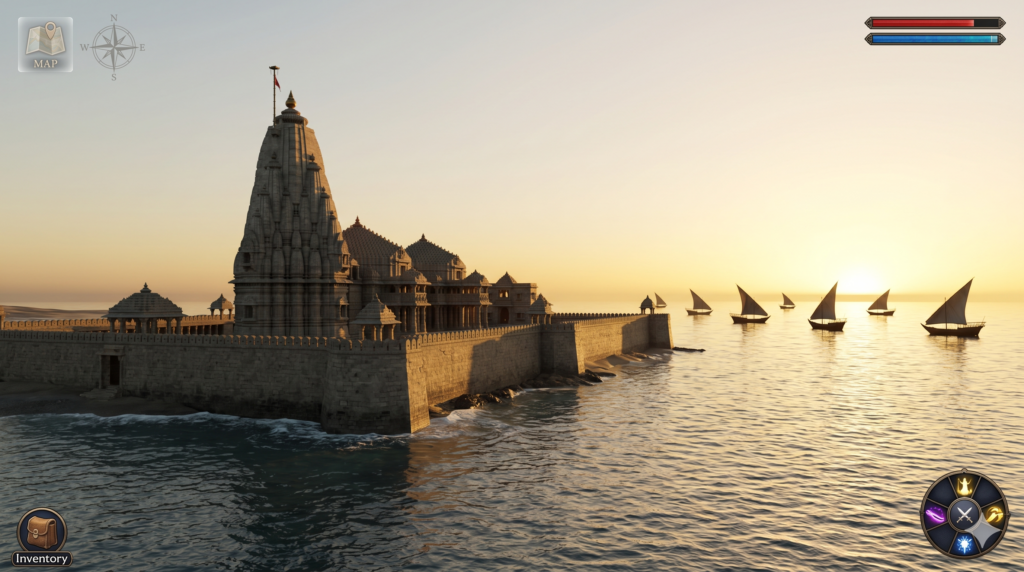
It rises 155 feet above you.
Seven storeys of yellow sandstone in the Māru-Gurjara style — the architectural language of Gujarat’s master masons, the Sompura Salats, who have been building and rebuilding temples on this coastline for over a thousand years. The shikhara — the central spire — rises 15 metres above the sanctum. Above it, an 8.2-metre flag pole. At the very top, a kalasha — a sacred pot vessel — that weighs 10 tonnes.
The temple carries 212 relief panels. Every surface is carved. Not decorated — carved, in the sense that the stone has been worked to carry meaning in every square inch of its face. The figures are not ornamental. They are documentary — the visual record of a belief system, a cosmology, a civilisation’s understanding of itself, cut into the stone that frames the dwelling place of Shiva.
This is the seventh version of this temple. The one that Sardar Vallabhbhai Patel stood before the ruins of on the evening of 13 November 1947 — the day after Diwali, the day India integrated Junagadh — and declared would be rebuilt. The one that President Rajendra Prasad consecrated on 11 May 1951 while the government tried to suppress the broadcast of his speech, and he went anyway.
But the metaverse does not begin here. It begins much earlier. And to reach the beginning, you need to know why this place exists at all.
The Moon God’s Debt
The site of Somnath has been a pilgrimage site from ancient times on account of being a Triveni Sangam — the confluence of three rivers: the Kapila, the Hiran, and the Sarasvati.
The name of the town — Prabhas, meaning lustre — comes from the story the place tells about itself. Soma, the moon god, lost his radiance because of a curse. To regain his splendour, he bathed in the Sarasvati River at this very site. This legend is believed to be the reason for the waxing and waning of the moon. The moon god’s debt, paid at this confluence, visible in the sky every month.
Somnath means Lord of the Moon. The temple stands where a god came to be healed.
The 5th-century poet Kalidasa, in his Raghuvamsa, lists Somnath-Prabhasa among the most revered Shiva pilgrimage sites of his time — alongside Varanasi, Ujjain, Prayaga, and Pushkara. By the 5th century CE, this coastline was already ancient in its sacred geography. Pilgrims had been arriving here for longer than any surviving inscription records.
By the time the great temple was built, it was not simply a religious site. Al-Biruni, the 11th century Persian polymath who accompanied Mahmud’s forces and documented the Indian subcontinent with the rigour of a modern anthropologist, described the temple’s location as on the coast of the Indian ocean, so that at the time of flow the tide bathed the idol. The temple and the sea were in conversation — the ocean arriving daily at the threshold of the sanctum like a devotee who cannot stay away.
At its height, the temple employed 300 musicians, 500 dancing girls, and 300 barbers — all permanently on the temple payroll. This was not a shrine. It was a civilisation within a building — a complex of such economic and cultural weight that it drew traders from east Africa to China, pilgrims from every corner of the subcontinent, and eventually the attention of every invader who heard of its wealth.
Version 1 — The Somnath Temple at Its Peak
Toggle the interface. You step back to the temple as it stood in the early 11th century — before 6 January 1026.
The yellow sandstone of the 1951 version is gone. What surrounds you now is a structure built in phases across centuries, the most recent additions made in the reign of Bhima I of the Solanki dynasty — stone replacing whatever came before, the temple growing with every generation that added to it.
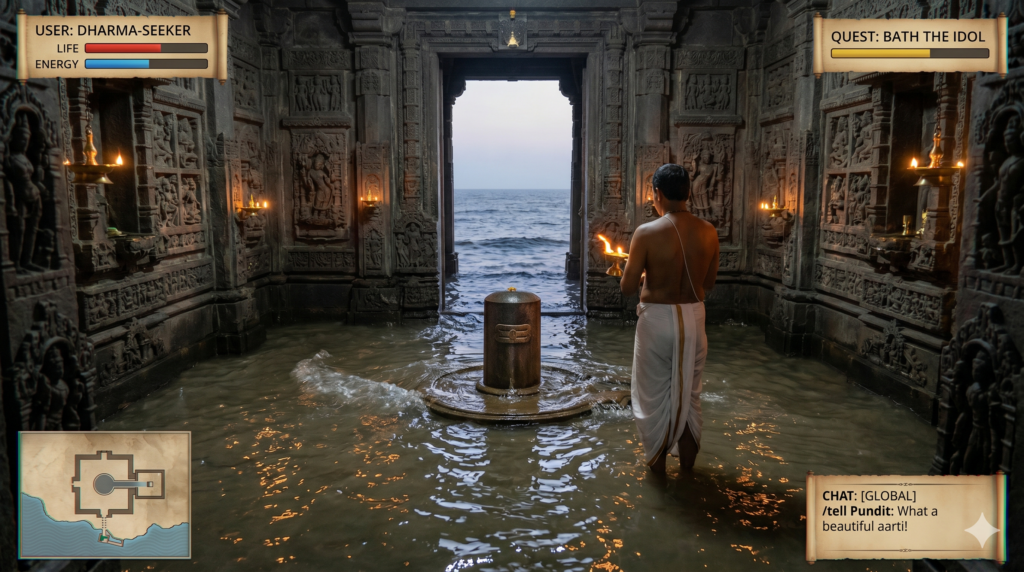
The sanctum holds the Jyotirlinga — the first among the twelve in all of India, listed first in the Shiva Purana, the sacred flame-form of Shiva that does not require installation or consecration because it is self-manifested. The tidal water of the Arabian Sea reaches the base of the temple twice a day. The air inside carries salt and incense simultaneously.
Around you, the sounds of a living institution at its height. Music from the 300 musicians employed by the temple trust. The sound of the sea.
This is what Al-Biruni described with such detail and such evident awe that his description, when it reached Ghazni, made the temple’s destruction feel like an ambition worth the crossing of the Thar Desert.
The Morning of 6 January 1026
The metaverse carries a layer you can enter but may not want to stay in long.
On 18 October 1025, Mahmud of Ghazni had embarked from Ghazni leading 30,000 cavalry. Each soldier was given two camels for essential resources. They crossed the Thar Desert — a route chosen specifically to avoid the armies that would have intercepted him on the plains. By the time intelligence of his approach reached Gujarat, there was not enough time to mount a coordinated defence.
The Ghaznavid army stood before the fortress of Somnath on Thursday, the 6th of January, 1026.
Al-Biruni, who documented the raid, recorded what Mahmud did upon entering the sanctum. He ordered the upper part of the Jyotirlinga to be broken. He had the fragments loaded onto camels for transport to Ghazni. Part of the idol was thrown into the hippodrome of Ghazni. Another part lies before the door of the mosque of Ghazni, on which people rub their feet to clean them from dirt and wet. This account is from Al-Biruni himself — a scholar, not a propagandist, writing for an audience that wanted accuracy.
Mahmud plundered 20 million dinars, including the temple’s and city’s gold, carried in caravans to a Friday mosque in Ghazni.
Here is what the archaeological record tells us happened next, and it matters: a 1038 CE inscription of the Kadamba king of Goa is puzzlingly silent about Ghazni’s raid or the temple’s condition. Twelve years after the attack, a visiting king from the Konkan coast wrote about Somnath without describing ruins. The temple had been repaired. The pilgrimage had resumed. The institution that employed 300 musicians and 500 dancing girls had rebuilt its functioning core within a generation.
This is Somnath’s deepest characteristic. It does not wait to be rebuilt. It rebuilds.
The Five Destructions. The Seven Versions.
The platform holds each one.
Toggle to 1299. Alauddin Khalji’s army under general Ulugh Khan arrives during the Gujarat invasion. The temple is desecrated. Mahipala I of the Chudasama dynasty rebuilds it. His son Khengara reinstalls the Jyotirlinga.
Toggle to 1395. Zafar Khan, founder of the Gujarat Sultanate, attacks. The structure is damaged. Local rulers repair what can be repaired.
Toggle to 1451. Mahmud Begada, Sultan of Gujarat, desecrates the site. The cycle continues.
Toggle to 1665. Aurangzeb orders its destruction. The most complete demolition since 1026. The temple is left in ruins. The Jyotirlinga is removed for safekeeping. For 118 years, the main structure stands broken and unused.
Then, 1783. Ahilyabai Holkar.
Version 6 — The Queen Who Kept the Flame
The Maratha queen of Indore arrived at Somnath in 1783 and found a site in ruins. Aurangzeb’s demolition had taken the structure 118 years before. What remained was broken walls and the absence of the institution that had once made this coast ring with music and prayer.
She did not attempt to rebuild the grand structure. She built a modest shrine — small enough not to attract what grandeur attracts, large enough to hold a consecrated Jyotirlinga and the priests who would tend it. Deliberately humble. Strategically quiet.
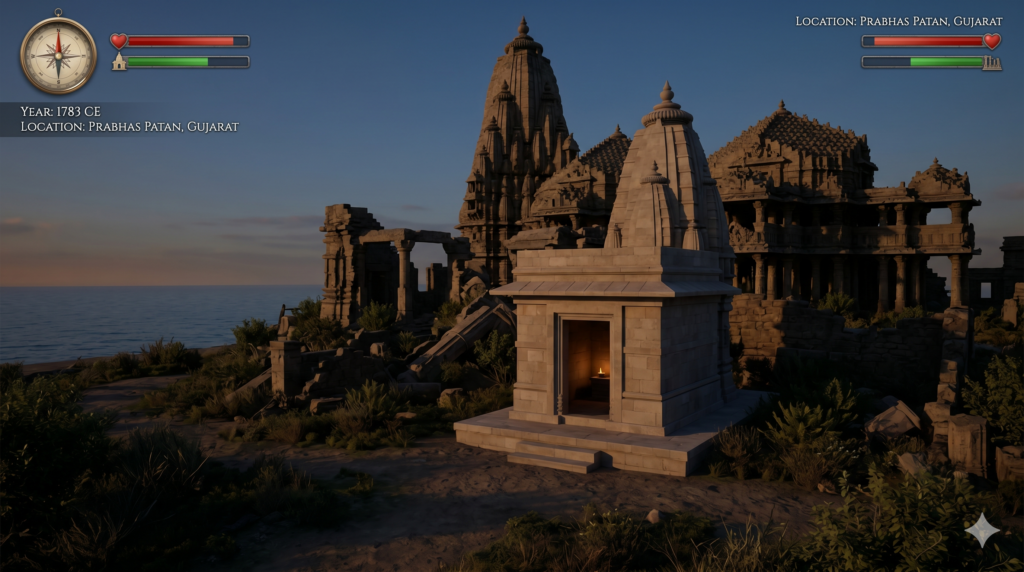
Her temple — now known as Old Somnath or Ahilyabai Mandir — stands approximately 200 metres from the current main temple. It remains an active place of worship. Without her intervention, the pilgrimage tradition that Patel and Munshi and Rajendra Prasad revived in 1951 might have had nothing living left to revive.
The metaverse holds this version too. Stand in it and feel the contrast — the small shrine on the great coastline, the modest arch over the same Jyotirlinga that once commanded the wealth of the ancient world’s trade routes. There is a kind of courage in restraint. Ahilyabai Holkar’s Somnath is its purest expression.
Version 7 — Sardar Patel’s Declaration
The evening of 13 November 1947.
India had been independent for less than four months. Sardar Vallabhbhai Patel had just completed the integration of Junagadh into India. He stood before the ruins of Somnath accompanied by N.V. Gadgil, Minister of Works, and the Jam Saheb of Nawanagar, and addressed a gathering of local residents.
He called the reconstruction “a holy task in which all should participate.” This was not the announcement of a construction project. It was the declaration of a civilisational renewal.
He wrote to Gandhi the same day. Gandhi blessed the project on one condition — no government funds. Public donation only. The temple that had sustained itself on the offerings of the ancient world’s trade routes would be rebuilt by the free citizens of a free India, one contribution at a time.
The architect was Prabhashankarbhai Oghadbhai Sompura — from the same hereditary lineage of master masons who had built and rebuilt temples on this coast for generations. The reconstruction plans are preserved at the Library of Congress in Washington DC. The plans of an Indian temple’s seventh rebuilding are held in the archive of America’s national library — a detail that contains an entire story about the global significance of what was being done
Patel died in December 1950, before the consecration. Nehru opposed official involvement and instructed All India Radio to minimise the broadcast. President Rajendra Prasad’s response was constitutionally and morally precise: “Our state is neither irreligious nor anti-religious. I would do the same with a Mosque or Church if I were invited.” He proceeded to Somnath.
On 11 May 1951, Rajendra Prasad consecrated the seventh Somnath. In his speech — the one the government tried to suppress — he said: “The Somnath temple signifies that the power of reconstruction is always greater than the power of destruction.”
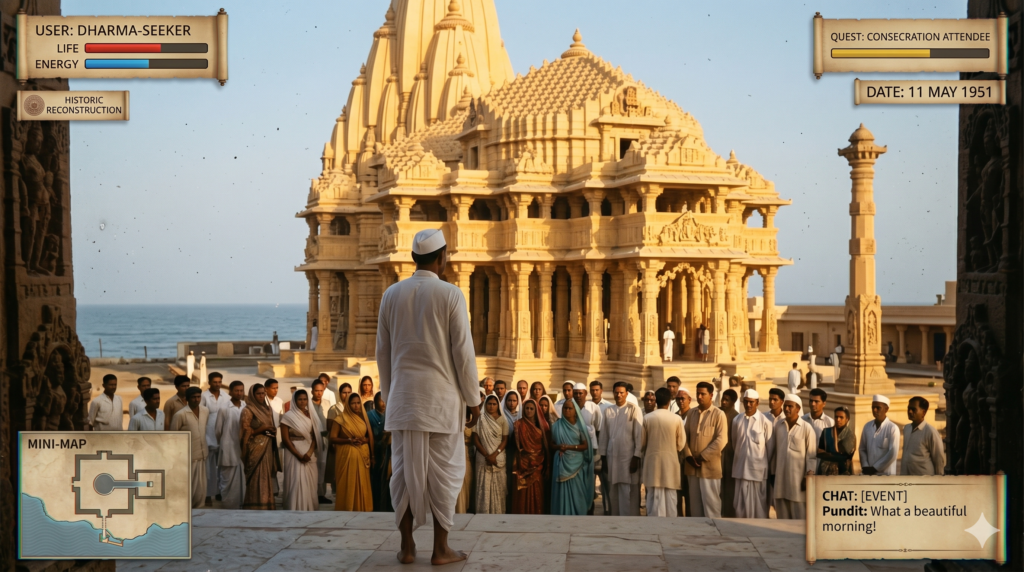
The platform renders this moment. The temple gleaming in the Gujarat sun. The sea behind it. The 155-foot shikhara catching the morning light over the Arabian Sea.
Walking Between the Versions of Somnath Temple
This is what the Somnath metaverse makes possible that no physical monument can.
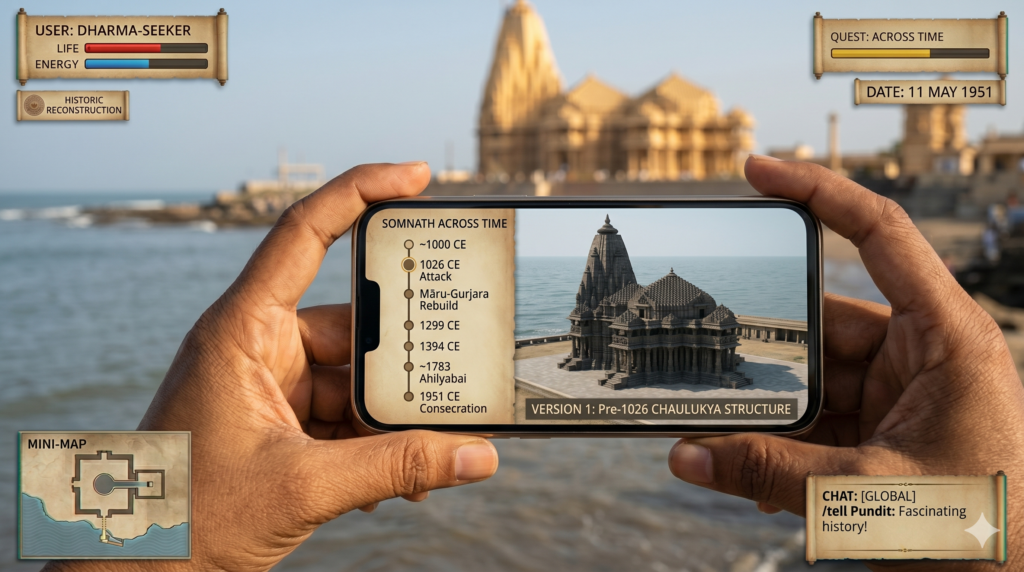
Stand in the courtyard of Version 1 — the temple at its height in 1025, tidal water at the threshold, 300 musicians employed within its walls, the Jyotirlinga in the sanctum that the tides bathe daily. Feel the scale of what existed.
Toggle. Ahilyabai Holkar’s modest 1783 shrine — the same coastline, the same Jyotirlinga, the same Arabian Sea, a fraction of the scale. Feel what it means to protect something rather than celebrate it.
Toggle again. Sardar Patel’s 1951 temple — 155 feet of yellow sandstone rising toward the Gujarat sky, 212 carved panels, the Baan-Stambh inscription pointing toward Antarctica. Feel what it means to rebuild not just a structure but a statement.
Three versions. Seven centuries compressed into three toggles. The full arc of a civilisation’s relationship with a single sacred site — from grandeur to devastation to quiet survival to triumphant return — navigable from a phone in your hand, wherever you are.
A Gujarati in New Jersey who has not been back in twenty years. A student in Kochi who has never been to Gujarat. A pilgrim in Varanasi who has heard this name since childhood and never made the journey.
All of them standing at the edge of the same Arabian Sea.
All of them facing the same Jyotirlinga.
Last but not the least, all of them in a place that the ancient world called Prabhas — lustre — because a god came here to recover his light.
The Metaverse Argument for Somnath
Nalanda was destroyed and never physically rebuilt. The metaverse argument there is: rebuild what cannot be physically recovered.
Martand was destroyed and never rebuilt at all. The metaverse argument there is: restore what has been left broken.
Somnath was destroyed five times and rebuilt seven times. The structure stands today in its full 155-foot glory, drawing 10 million pilgrims a year. The metaverse argument here is different from both, and it is arguably the most powerful of the three: show all seven versions of the same sacred site simultaneously, let a visitor move between them freely, and in doing so give them the one thing no single version of the temple can give alone — the full depth of what this place has survived.
The data exists. The ASI holds the archaeological survey of the site. The Shree Somnath Trust holds the 1951 architectural drawings. British-era records from Alexander Burnes and James Todd document earlier versions. The Prabhas Museum near the temple holds fragments of earlier structures. One of its most fascinating exhibits is the old Jyotirlinga fragment, preserved as a historical relic.
Read about Martand Sun Temple in Metaverse
The technology exists. The will — demonstrated most recently by the Somnath Amrut Mahotsav of May 2026, where Prime Minister Modi stood at this coastline and said that the consecration of Somnath in 1951 proclaimed the awakening of India’s independent spirit — is gathering momentum.
The Somnath metaverse does not exist yet. The temple does. The sea does. The Baan-Stambh inscription does. The seven versions of this structure across a thousand years of Indian history — each one an act of faith against an act of destruction — all of that is waiting.
The only thing missing is the decision to build the platform that makes all of them walkable.
The above content wouldn’t have been possible without the help of Google Gemini and Anthropic Claude
Sources and Verified Links
- Triveni Sangam — Kapila, Hiran, Sarasvati rivers; Somnath as first Jyotirlinga — Wikipedia / Somnath Temple: https://en.wikipedia.org/wiki/Somnath_temple
- Kalidasa’s Raghuvamsa 5th century — Somnath listed among revered Shiva tirthas alongside Varanasi, Ujjain — MyAdhyatm: https://myadhyatm.com/somanatha-temple-or-deo-patan/
- Moon god Soma bathed in Sarasvati at Prabhas to regain lustre — BharatStory: https://bharatstory.in/index.php/2023/04/10/history-of-somnath-temple-ruin-to-resurrection/
- Al-Biruni on tidal water bathing the idol, temple on Indian ocean coast — Wikipedia / Somnath Temple: https://en.wikipedia.org/wiki/Somnath_temple
- Temple employed 300 musicians, 500 dancing girls, 300 barbers — Lonely Planet: https://www.lonelyplanet.com/pois/1154099
- Mahmud departed 18 October 1025, 30,000 cavalry, two camels per soldier — Wikipedia / Sack of Somnath: https://en.wikipedia.org/wiki/Sack_of_Somnath
- Army stood before Somnath on Thursday 6 January 1026 — Academia.edu / Somnath Expedition: https://www.academia.edu/44591424/The_Somnath_Expedition_of_Sultan_Mahmud_of_Ghazni
- Al-Biruni account — idol fragments in hippodrome and mosque steps at Ghazni — Dharma Dispatch: https://www.dharmadispatch.in/history/never-forget-how-mahmud-of-ghazni-devastated-the-original-somanatha-temple
- Mahmud plundered 20 million dinars; 1038 Kadamba inscription silent on raid — Wikipedia / Somnath Temple: https://en.wikipedia.org/wiki/Somnath_temple
- Baan-Stambh inscription — no land between Somnath and Antarctica — Vajiramandravi: https://vajiramandravi.com/current-affairs/somnath-temple/
- Current temple — 155 feet tall, seven storeys, yellow sandstone, Māru-Gurjara style — News9live: https://www.news9live.com/lifestyle/travel/somnath-temple-history-tourist-attractions-travel-guide-2970915
- Shikhara 15 metres above sanctum, 8.2-metre flag pole, 212 relief panels — Wikipedia / Somnath Temple: https://en.wikipedia.org/wiki/Somnath_temple
- Kalasha weighs 10 tonnes, flag mast 37 feet — Gujarat Expert: https://www.gujaratexpert.com/somnath-temple-architecture/
- Patel visited Junagadh ruins 13 November 1947, called it “a holy task” — SPMRF: https://spmrf.org/the-somnath-parva-is-an-eternal-proclamation-of-the-soul-of-the-indian-civilisation/
- Gandhi blessed project, condition of public funding only — InidaFaith: https://www.indiafaith.in/Encyc/2022/5/11/Last-consecration-of-the-Somnath-Temple.html
- Nehru opposition; Rajendra Prasad’s response — “Our state is neither irreligious nor anti-religious” — SPMRF: https://spmrf.org/the-somnath-parva-is-an-eternal-proclamation-of-the-soul-of-the-indian-civilisation/
- AIR blackout of Rajendra Prasad’s consecration speech — The Print: https://theprint.in/opinion/great-speeches/rajendra-prasads-somnath-temple-inauguration-speech-that-air-blacked-out-in-1951/1931491/
- Rajendra Prasad quote — “power of reconstruction always greater than power of destruction” — InidaFaith: https://www.indiafaith.in/Encyc/2022/5/11/Last-consecration-of-the-Somnath-Temple.html
- Reconstruction plans preserved at Library of Congress — Wikipedia / Somnath Temple: https://en.wikipedia.org/wiki/Somnath_temple
- Architect Prabhashankarbhai Oghadbhai Sompura, Sompura Salats lineage — Wikipedia / Somnath Temple: https://en.wikipedia.org/wiki/Somnath_temple
- Old Jyotirlinga fragment preserved in Prabhas Museum — Bon Travel India: https://www.bontravelindia.com/somnath-temple/
- PM Modi at Somnath Amrut Mahotsav May 2026 — “consecration of Somnath proclaimed India’s independent spirit” — PMIndia.gov.in: https://www.pmindia.gov.in/en/news_updates/pms-speech-at-the-somnath-amrut-mahotsav-in-prabhas-patan-gujarat/
- Somnath Amrut Mahotsav — 75 years since consecration, President Rajendra Prasad inauguration — DD News: https://ddnews.gov.in/en/gujarat-pm-modi-pays-tribute-to-sardar-patel-at-somnath/
- Ahilyabai Holkar 1783 temple — Mahakali Temple at Prabhas Patan — Wikipedia / Prabhas Patan: https://en.wikipedia.org/wiki/Prabhas_Patan
Author







Wow! That’s a really interesting way to witness history unfold firsthand. The entire journey of this temple is quite intriguing.
Somnath Mandir is one of the best preserved monument of the world with high religious sentiment!
Oh, wow! That doesn’t even look real! It’s like something right out of a fantasy movie. I love the history and culture behind it, as well.
Beth, I am glad you think so and I’m not surprised at your observation. Afterall, Cinema is inspired by stories of destruction and revival.
That is quite a history. I didn’t get there when I was in India a few years back, but am sorry I didn’t. The site is steeped in history and culture. I hadn’t realized its significance before.
Maybe it is an indication for you to return to India with a fresh itinerary!
wow! What a view, what a place! Adding Somnath Temple to my bucket list, no doubt it’s a place worth visiting once in a lifetime.
It is definitely a place to visit once in a lifetime!
This was a fascinating read about Somnath Temple’s rich history and resilience. I appreciated how clearly you explained its spiritual importance alongside the stories of destruction and rebuilding.
i’m glad you liked my researched article!
And most people have never even heard of Somnath Temple. It’s got quite a rich history, as I have now learned.
Somnath temple is a must visit for all history lovers!
Oh wow, what a breathtaking temple. I’d love to see this in person one day. The story is incredible.
Somnath Temple is actually a wonder of wonders!
This was a fascinating read. The idea of experiencing all seven versions of Somnath in one place is powerful. Its interesting to read about the temples journey through destruction, survival, and renewal. History feels far more alive when you can walk through it.
Totally agree with you on the point that History comes alive when we walk through it!
What a fascinating place and the power of seven. I thoroughly enjoyed reading about Somnath Temple. I think it ought to be considered as a UNESCO World Geritage site.
I couldn’t agree more! Praying for the day when it is declared as a UNESCO World Heritage site!
What a fascinating feature. The combination of history, heritage, and stunning architecture makes this an incredible landmark to learn about and visit. Thanks for sharing this journey.
Glad you liked this research post on Somnath temple!
It’s incredible what technology can do! I imagine this would be such a unique experience to seemingly walk through at all of these different stages of history.
It took me a lot of history digging and prompting to make this post. I am glad you liked it!
Wow, this is absolutely breathtaking! It almost looks unreal, like a scene from a storybook. I also love the rich history and culture behind it. Places like this make me want to travel and learn more.
It is absolutely stunning and the context of the temple makes it even more appealing!
I found the idea of walking through all seven versions in one space really fascinating. It made history feel less distant somehow, especially with details like Ahilyabai Holkar’s quiet rebuilding and the final reconstruction after independence. There’s a lot of feeling in this piece without it becoming heavy.
Sonia, I think you are in sync with the Indian culture. You must plan a visit to India and Somnath temple in the near future!
Must be pretty cool to visit that temple. Cool to think there have been so many people that were employed in it
Somnath Temple has been one of the biggest cases of demolition yet it is source of divine spiritual energy! If you are planning a trip to India, you must plan to visit it.
The amount of research you’ve done is amazing! And what a tale of history. India is rich in this kind of mystical history and I love it!
I am glad you liked the well researched blog post!
I was fascinated by Somnath Temple’s extraordinary history and resilience. Your journey through its many destructions and rebuildings beautifully captures how faith, heritage, and perseverance can keep a sacred place alive.
I couldn’t agree more, Jerry!
Incredible. The uses of technology to enrich are lives boggle my mind. The history lesson of the temple was fascinating and engaged me throughout.
Richard, I am glad you liked the writeup. It was meant to pass on this feeling only!
Reimagining the Somnath Temple through the metaverse is an incredible way to experience a long history of civilisational resilience. Letting users walk through all seven historical versions, from its ancient architectural peak to the 18th-century shrine helps to brings history alive. The connection between the sacred site and the Arabian Sea across centuries is beautifully captured.
Thank you Lani. Hope to continue writing better for you and others!
What an incredible story of resilience—the fact that Somnath Temple has endured centuries of destruction and rebuilding makes its history so powerful. I especially loved the idea of using the metaverse to experience its different versions through time; what a fascinating way to preserve history and help future generations truly connect with it.
Wow, amazing, the idea of walking through all seven versions in a metaverse is striking. The contrast between the grand early temple and Ahilyabai’s quiet shrine is a nice one. 🙂
The idea of virtually walking through all the different versions of Somnath is fascinating. It’s not just about seeing the architecture, but understanding how the place kept being rebuilt through the centuries. Such a creative way to bring history and heritage closer to people who may never get to visit in person.