
The Sun Temple That Refused to Disappear

Imagine Apple building its headquarters not in Cupertino, but on top of a mountain — designed so every window faces the sun, visible from 50 kilometres away, and constructed without a single screw or bolt. Now imagine it being deliberately demolished over the course of a full year, and still not coming all the way down.
That’s roughly the story of Martand.
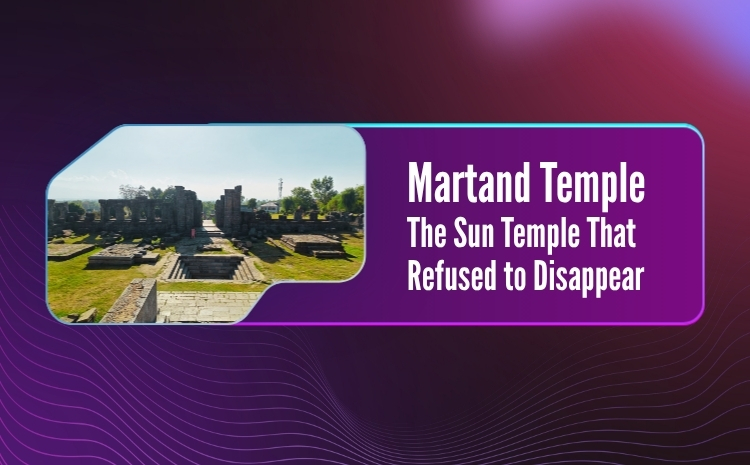
The Martand Sun Temple sits on a plateau in Mattan, Anantnag district, in the Kashmir Valley — about 2,000 metres above sea level, with the entire valley spread below it like a map. It has been in ruins for six centuries. And it is still, somehow, one of the most jaw-dropping things you can stand in front of in India.
King Lalitaditya’s giant flex
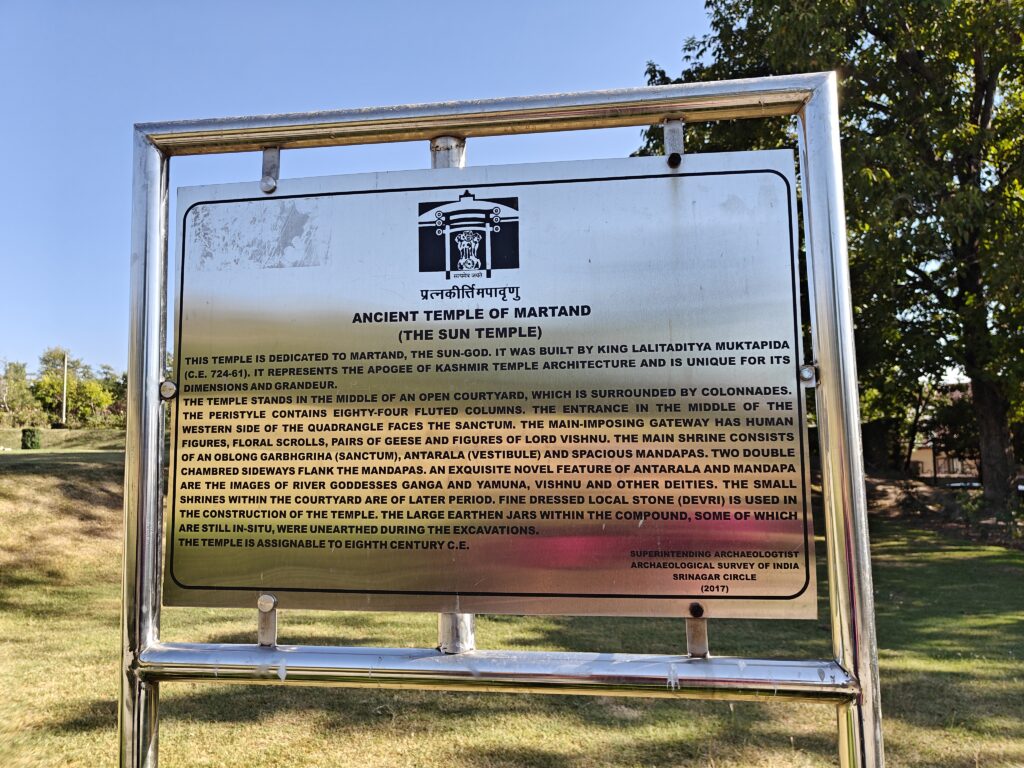
Lalitaditya Muktapida’s reign from 724 to 761 CE is considered a golden age for Kashmir — a period of military conquests, architectural ambition, and expansion of the kingdom well beyond its borders. He was, by all historical accounts, Kashmir’s most powerful king. And like all powerful rulers throughout history, he wanted to build something that would outlast him.
He picked the highest plateau he could find. Then he built a temple complex so ambitious that no one has built anything comparable in Kashmir before or since.
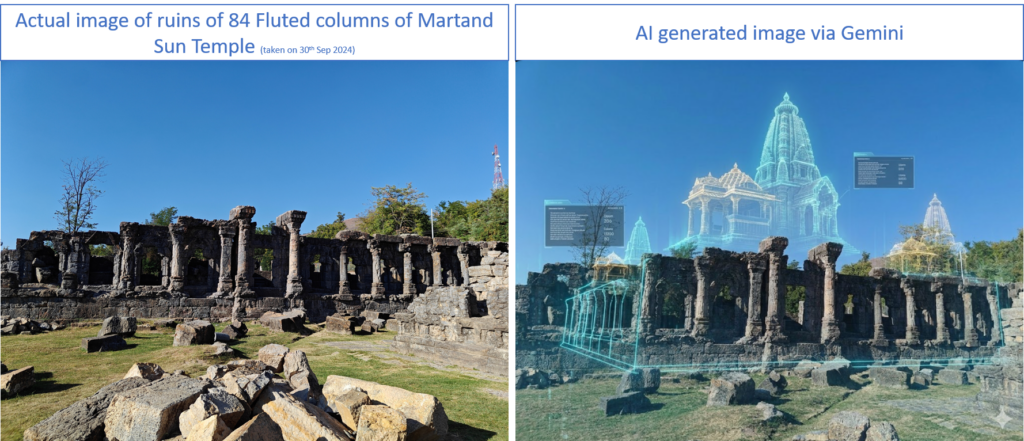
The courtyard stretches 220 feet long and 142 feet wide, with the primary shrine at the centre surrounded by 84 smaller shrines — representing the 84 forms of the Sun God. The colonnade of shrines ringing the perimeter makes it the largest example of a peristyle in Kashmir. For reference, a peristyle is the kind of colonnaded walkway you associate with ancient Greek temples. Which brings us to the really interesting part.
This temple was basically an architectural remix
Nobody in the 8th century was building temples that looked like this. Martand was an excellent specimen of Kashmiri architecture — blending Gandharan, Gupta, Chinese, and possibly Syrian-Byzantine forms. The capitals and pillars show Corinthian-style detailing. Trefoil-arched doorways. The overall spatial logic has a Chinese courtyard sensibility. The proportional system is Gupta Indian.
Think of it as the 8th-century equivalent of a building that looks like it was designed by an Indian architect who’d trained in Rome, taken a fellowship in China, and then come home to Kashmir with strong opinions.
The entrance — on the western side of the quadrangle — is the same width as the temple itself. That’s a deliberate power move in classical architecture. You’re not walking into a building. You’re walking into a statement.
The main shrine consists of an oblong garbhagriha (sanctum), antarala (vestibule) and a spacious mandapa, with two double-chambered side structures flanking the mandapa — described as novel and special features of the temple. The carvings on the walls of the antarala and mandapa include Ganga, Yamuna, Vishnu, and other deities — with the imposing gateway bearing human figures, floral scrolls, pairs of geese, and figures of Vishnu.
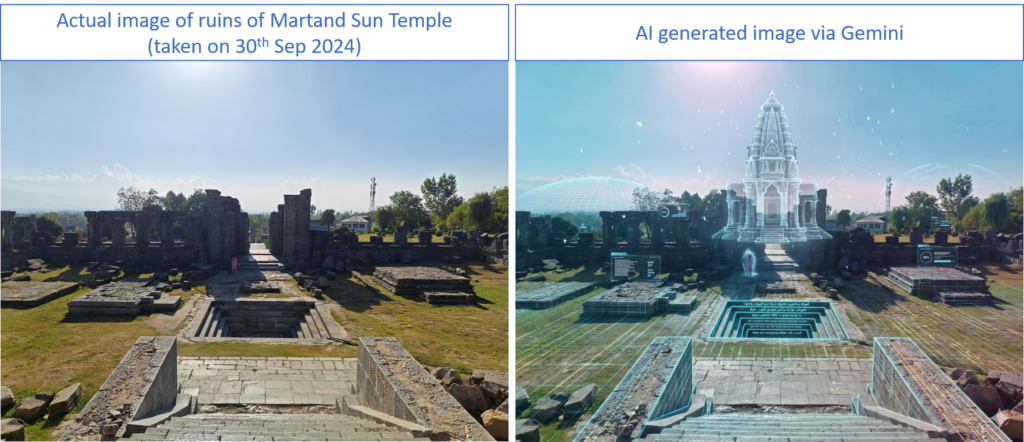
The whole complex was aligned so that sunlight fell on the main idol of the Sun God throughout the day — not accidentally, but by design. The builders were tracking the sun. On the plateau closest to it.
The view from Martand Temple
Here’s what I want you to picture. You’re a pilgrim in the 9th century. You’ve walked for three days from Srinagar. You climb the plateau at dawn. And rising in front of you, catching the first light before the rest of the valley does, is a 63-foot stone temple with a pyramidal crown, surrounded by 84 smaller shrines, the whole thing glowing in grey limestone against a sky full of Himalayan peaks.
It is said to be the most unusual Hindu structure a well-travelled visitor has ever seen — with no parallel despite visits to over 300 places across India and abroad.
That’s not marketing copy. That’s a traveller in 2024, standing in the ruins, still gobsmacked.
The year-long demolition
According to Jonaraja and Hasan Ali, the temple was destroyed by Sikandar Shah Miri between 1389 and 1413, in a campaign to Islamise society under the advice of Sufi preacher Mir Muhammad Hamadani.
The demolition took a year. Not a week. Not a month. A full year of sustained effort to bring it down — which tells you everything about how well it was built. The dry stone technique — ashlar masonry with precisely cut blocks placed without mortar — gave it structural integrity that outlasted the people trying to destroy it.
Even Sikandar, reportedly, couldn’t fully finish the job. The walls still stand.
Why this matters right now
In March 2024, the Jammu and Kashmir government initiated formal efforts to restore the temple. Stone sculptures within the complex — including a four-armed Brahma — hold great religious significance for Kashmiri Pandits, who rank Martand among their three holiest pilgrimage destinations.
But beyond religion and politics, there is something quietly extraordinary about a building that was designed to catch the light of the sun — that was built as a conversation between six different architectural traditions — surviving six centuries of deliberate destruction, neglect, and time.
Most brands spend millions trying to build identity that lasts a decade.
Martand has been making its argument for 1,300 years. In ruins.
If you’ve been to Martand, or if this made you want to go — drop a comment. And if you know someone who builds things meant to last, send this their way.
Last, but not the least, a special thanks to Mr Uday Sahay and Dr Poonam Saxena who authored the Kayastha Encyclopedia
Sources
Wikipedia — Martand Sun Temple: en.wikipedia.org/wiki/Martand_Sun_Temple
Kayastha Encyclopedia- https://www.kayasthencyclopedia.com/
Incredible India (Ministry of Tourism, GoI): incredibleindia.gov.in/martand-sun-temple
Dharmic Vibes — The Lost Glory of Kashmir’s Ancient Sun Worship: blog.dharmikvibes.com
A Soul Window — Martand Sun Temple Guide (first-person visitor account): asoulwindow.com/martand-sun-temple-guide
Scribd — Martand Sun Temple Case Study (architectural detail): scribd.com/document/939761323
Culture & Heritage of India: cultureandheritage.org/martand-sun-temple
Kalhana’s Rajatarangini (12th century CE) — referenced via multiple secondary sources above
Author