
Nalanda, Reimagined — From Ashes to Algorithms

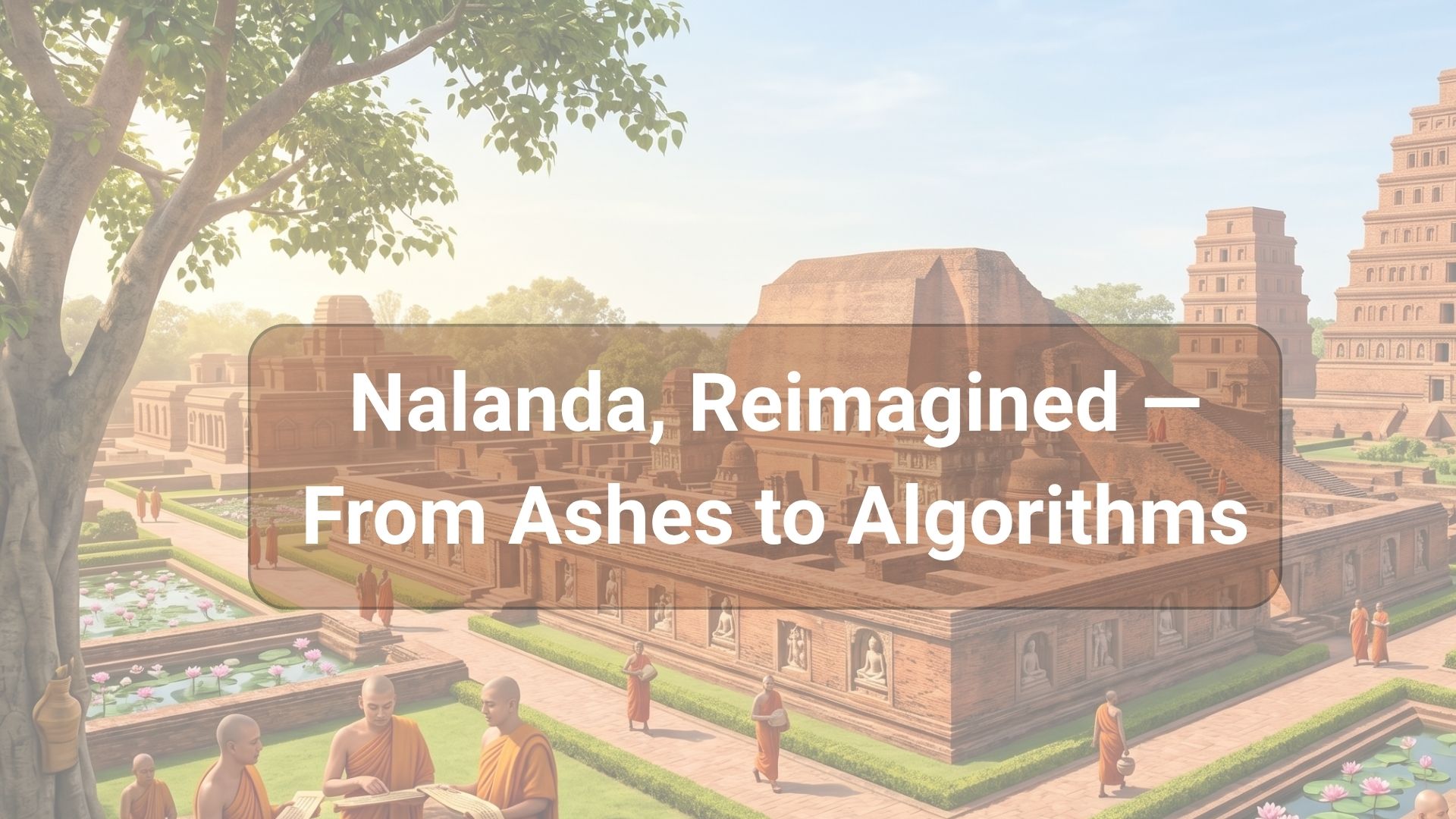
What 9 million manuscripts, one act of conquest, and a technology born in the 21st century have in common — and why it matters more than any game ever will.
A quick and important clarification before you read a single word further.
Nalanda does not exist in the metaverse. Not yet.
In 1193 CE, somewhere in the plains of Bihar, a fire started that the world is still mourning.
The library at Nalanda — three towering multi-storeyed buildings holding manuscripts on medicine, astronomy, mathematics, philosophy, logic, and the accumulated wisdom of 800 years of scholarship — was set ablaze. According to historical accounts and Tibetan records of the period, the fire burned for approximately three months. Not three days. Three months. Because there was that much knowledge inside.
The library was called Dharmaganja — Mountain of Truth. It was so vast that smoke from the burning manuscripts hung for days like a dark pall over the low hills surrounding it.
What Nalanda was, at its peak, is almost impossible to hold in the mind.
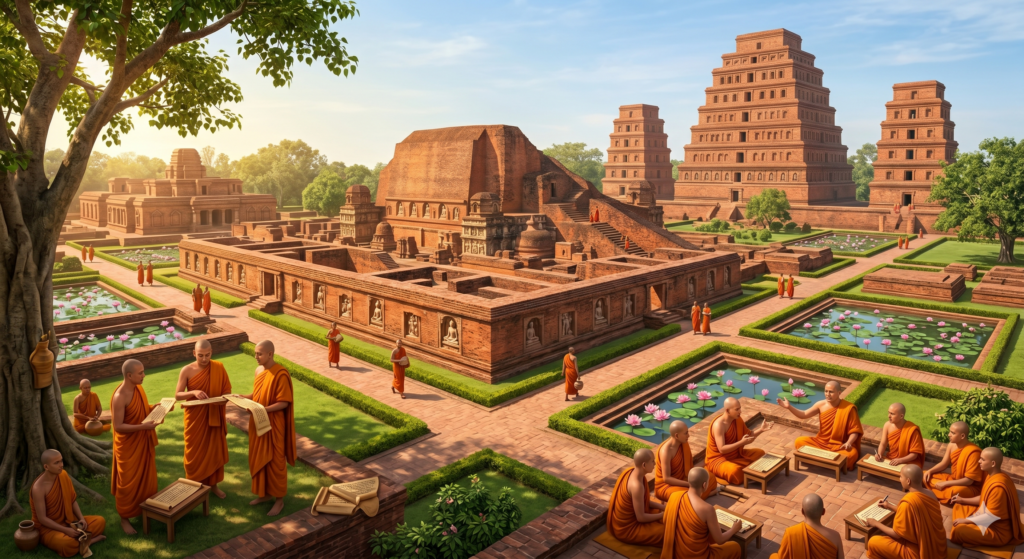
At its peak, Nalanda accommodated more than 2,000 teachers and over 10,000 students, attracting scholars and students from as far away as China, Indonesia, Korea, Persia, Tibet, and Turkey. It was founded in the 5th century CE — predating the University of Bologna by over 600 years, and Oxford by more than 600 years as well. Students were not simply admitted. Senior scholars used to examine the students and those who would demonstrate sufficient learning could enter.
The subjects taught included Buddhist philosophy, Vedic scriptures, logic, grammar, medicine, mathematics, and astronomy. The library complex consisted of three multi-storeyed buildings — Ratnaranjaka (Jewel-adorned), Ratnodadhi (Sea of Jewels), and Ratnasagara (Ocean of Jewels).
All of it burned.
That is the loss we are living with.
What Was Actually Destroyed
Not just books.
The manuscripts at Nalanda contained original research. Scholars there were not copying existing texts — they were advancing knowledge. Works on mathematical principles that would not appear in Europe for centuries. Medical treatments documented by practitioners who had refined them across generations. Astronomical calculations. Philosophical frameworks. Systems of logic.
Author D.C. Ahir considers the destruction of the temples, monasteries, and centres of learning at Nalanda and northern India to be responsible for the demise of ancient Indian scientific thought in mathematics, astronomy, alchemy, and anatomy.
The loss was not merely cultural. It was scientific. It set back the development of knowledge in ways we cannot fully measure because we do not know what was in those manuscripts.
And here is the thing that makes this relevant to everything that follows in this newsletter series:
That loss is not necessarily permanent anymore.
Revival of Nalanda
Now imagine what becomes possible.
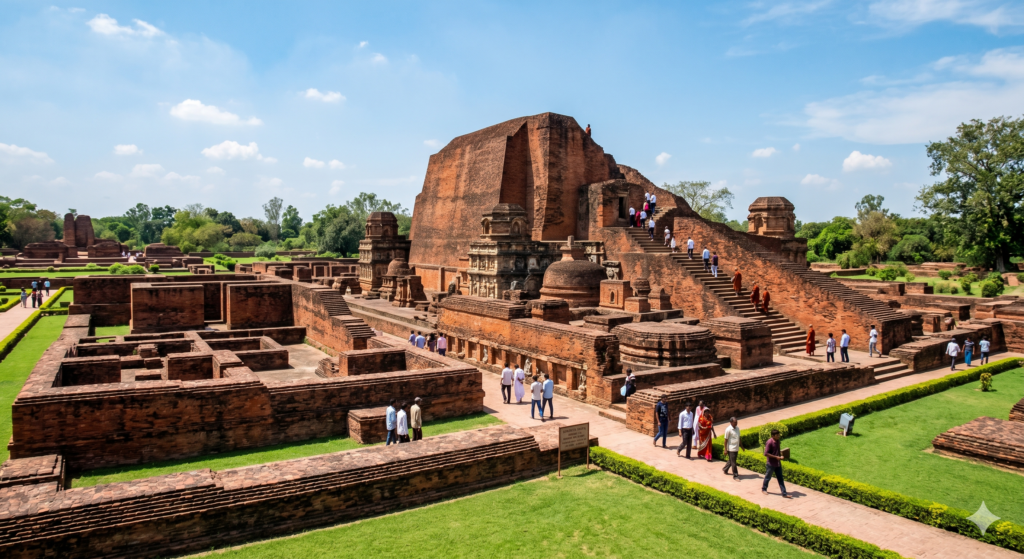
The excavated area at Nalanda covers approximately 23 hectares — but estimates suggest this represents only about 10% of the total site. The rest lies beneath agricultural land and modern settlements. Nalanda is a UNESCO World Heritage Site, inscribed in 2016. Systematic excavations since 1915 have unearthed eleven monasteries, fourteen temples, a sophisticated drainage system, and layers of construction showing centuries of rebuilding and expansion.
We have an extraordinary amount of data about what Nalanda was. What we do not have is a way for the world to experience it.
A Nalanda metaverse — built on the archaeological record, verified by historians, navigable from any phone or computer — would allow a student in Patna to walk through the lecture halls as they stood in the 7th century. A researcher in Tokyo to study the spatial relationship between the library buildings and the monastery courtyards. A teacher in Bengaluru to conduct a class inside the space where Xuanzang, the famous Chinese scholar-monk, sat and studied for two years in 637 CE.
Not a film. Not a documentary. A space you move through, at your own pace, and return to.
The destroyed cannot be physically rebuilt. But virtually, it can be made navigable again. UNESCO described Nalanda as the institution that “engaged in the organised transmission of knowledge over an uninterrupted period of 800 years.” A metaverse can extend that transmission into the 21st century — for anyone in the world with a smartphone.
That is not entertainment. That is civilisational memory preservation. It is SDG 11, Target 11.4 — the UN’s goal for protecting and safeguarding the world’s cultural and natural heritage — made real and democratic and accessible.
And it is one of the most powerful arguments for why immersive civic technology deserves to be taken seriously by governments, historians, educators, and urban planners — not just by technology companies.
What Metaverse Actually Takes to Revive Nalanda
Before we get to Nalanda, let us address the myth this edition exists to demolish.
When people hear “metaverse,” they picture a teenager in a headset shooting things. What they do not picture is the extraordinary complexity of professionals, disciplines, and technologies required to build one. Understanding that complexity is the first step to understanding why this technology is genuinely serious — and why dismissing it as gaming reveals more about the dismisser than about the technology.
Building a meaningful metaverse environment — not a game, but a functional civic or heritage space — requires the simultaneous contribution of at least eight distinct professional disciplines.
- 3D modellers and environment artists who recreate physical spaces with architectural accuracy. For a heritage site like Nalanda, this means working from archaeological survey data, excavation reports, and historical scholarship to build spaces that are not invented but reconstructed from evidence.
- Game engine developers working in Unreal Engine or Unity — the same software used to create photorealistic film visual effects. They build the physics of the space: how light falls, how sound travels, how objects behave when touched.
- Historians and archaeologists who verify every design decision against the historical record. The placement of pillar also becomes significant. Its position, dimensions, and decoration must correspond to what excavation evidence tells us was actually there.
- Spatial audio engineers who design sound environments — because a space without accurate sound is not immersive. The way a courtyard echoes, the ambient soundscape of an ancient city, the acoustic properties of a lecture hall.
- AI engineers who build the intelligence layer — virtual guides, responsive environments, language translation, personalisation for different users.
- Cybersecurity and data architects who ensure the platform is secure, accessible, and compliant with data governance standards. For a civic or government metaverse, this layer is non-negotiable.
- User experience designers who ensure a student in rural Bihar, an elderly man in Patna, and a researcher in London can all navigate the same space intuitively, regardless of their technological fluency.
- Content strategists and communication professionals who build the narrative layer — because a technically perfect metaverse that nobody understands how to use or why it matters is just expensive software running on a server.
This is not game development. This is urban design, archaeology, architecture, AI engineering, data science, and communication design working in concert. The professionals who build a city metaverse are the same people who design cities, preserve heritage, develop AI systems, and govern public institutions.
The only thing it has in common with gaming is the engine under the hood — the same way a Formula 1 car and a city bus both have engines, but nobody confuses what they are for.
The Myth, Demolished
Let us be direct about what we are arguing here.
The metaverse is not a game. It is not a headset. It is not Meta’s failed cartoon avatar experiment. It is not something that belongs to Gen Z more than it belongs to anyone else.
Instead it is a technology for making places accessible, knowledge permanent, and experiences democratic.
The students who could not get admission to Nalanda because they had not studied enough — the technology now exists to bring Nalanda to anyone who wants to learn, regardless of where they were born, what language they speak, or whether they can travel to Bihar.
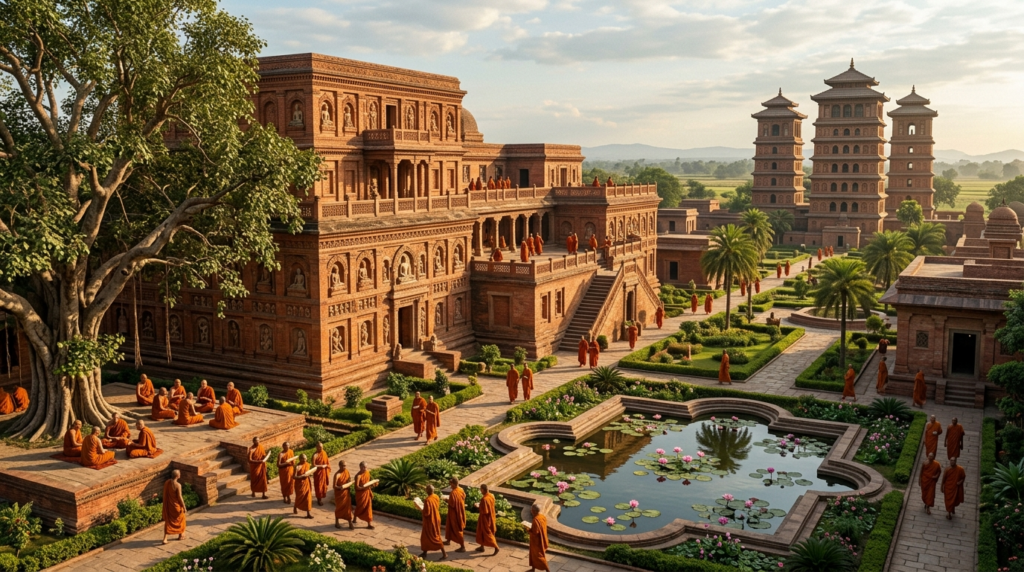
The manuscripts that burned for three months in 1193 — some portion of that knowledge survives in Tibetan translations and Chinese records. The architectural knowledge survives in excavation data. The subjects taught survive in subsequent scholarly traditions. A metaverse does not recover what was lost. But it builds a bridge across the destruction. Metaverse has the ability to build a living memory of Nalanda.
That is the technology we are talking about across this newsletter series. Not games. Not avatars floating in corporate meeting rooms.
Places that matter, made navigable again.
Sources
- Nalanda — library called Dharmaganja, smoke hanging over hills — rahul.biz comprehensive history: https://www.rahul.biz/bihar/nalanda-university-history
- Nalanda peak — 2,000 teachers, 10,000 students, scholars from China, Indonesia, Korea, Persia, Tibet, Turkey — Buddhistdoor Global / UNESCO: https://www2.buddhistdoor.net/news/ancient-nalanda-university-now-a-unesco-world-heritage-site
- Nalanda predates Bologna and Oxford by 600+ years — rahul.biz: https://www.rahul.biz/bihar/nalanda-university-history
- Library buildings — Ratnaranjaka, Ratnodadhi, Ratnasagara — Cultural India: https://culturalindia.net/monuments/nalanda.html
- Archaeological evidence of catastrophic fire — thick ash layer across multiple buildings — Wikipedia / Nalanda Mahavihara: https://en.wikipedia.org/wiki/Nalanda_mahavihara
- Historical debate on attribution of Nalanda’s destruction — The Wire: https://m.thewire.in/article/history/did-bakhtiyar-khilji-destroy-nalanda-university
- D.C. Ahir on destruction of Indian scientific thought in mathematics, astronomy, alchemy, anatomy — My India My Glory: https://www.myindiamyglory.com/2017/09/11/nalanda-9-million-books-burnt/
- Excavated area 23 hectares = 10% of total site — rahul.biz: https://www.rahul.biz/bihar/nalanda-university-history
- Nalanda UNESCO World Heritage Site inscription, 2016 — Wikipedia: https://en.wikipedia.org/wiki/Nalanda_mahavihara
- UNESCO: Nalanda engaged in organised transmission of knowledge for 800 years — Government of India PIB / UNESCO inscription: https://www.pib.gov.in/newsite/PrintRelease.aspx?relid=147142
- Professionals required for metaverse development — IT Career Finder: https://www.itcareerfinder.com/brain-food/blog/entry/great-jobs-in-the-metaverse.html
Author






Nalanda looks like it was the most incredible place to study, when it was in all of its glory! I mean, it still looks like a fantastic place to see today, if those reimagines ruins were real. I’d love to see a place like this.
Emily, you spoke what i had in mind!
Nalanda is so fascinating! What they’ve uncovered and restored is absolutely amazing, but my mind is really blown by the fact that so much more will be forever hidden under modern structures.
The library at Nalanda sounds like a mad man’s fantasy of the past yet it remains one of UNESCO’s most revered World Heritage sites. I hope to see the day when all that is envisioned come to fruition. There is nothing new on this planet just recoveries of ancient wisdom and scientific breakthroughs. Brilliant!
A lot of secrets and ways of life are hidden in ancient wisdom that we miss in our daily life. Thus, recovering them is the first step in the process of civilization!
Beth, we cant imagine what we shall uncover beneath the Nalanda! Much of it is intangible!
This is incredibly fascinating – both what was lost and how much was restored. It really makes you wonder what can never be found due to being under private lands and buildings.
Nalanda university is one of the biggest losses to the mankind! However, it’s revival is on the cards!
I love history, so this is fascinating to me. I hate that so much was lost though.
I wish i could go back in time and undo the damage! but alas I cant!
It is amazing how much has been restored, but also heartbreaking to think about what was permanently destroyed or may still remain hidden beneath private property and buildings.
I couldn’t agree more!