LinkedIn Post Boosting: Guide

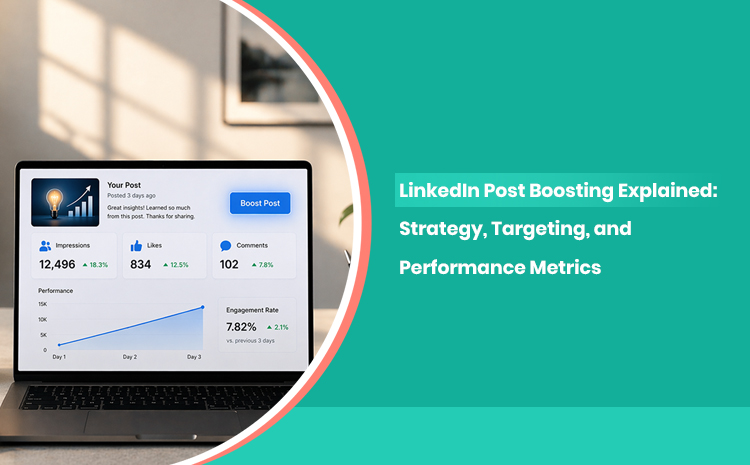
If your LinkedIn posts aren’t getting seen, it is probably because you’re losing relevance. LinkedIn is where decisions begin today. Before a call is booked or a proposal is opened, your content has already shaped perception. And yet, even strong content often struggles to break through.
That’s where boosting comes in as a multiplier.
Why LinkedIn Post Boosting Exists
Organic distribution on LinkedIn is no longer predictable.
- Reach is selective and not guaranteed
- Engagement is concentrated among a small percentage of viewers
- Timing has less impact than relevance
In simple terms, good content doesn’t always travel far enough on its own. Boosting solves the problem of distribution, not the problem of quality. It takes content and puts it in front of a more relevant audience, faster.
Read Another Blog on LinkedIn: On LinkedIn Accounts
What It Actually Means to Boost a Post
Boosting is the fastest way to turn an organic post into a paid asset. Instead of building a campaign from scratch, you:
- Select an existing post
- Choose a goal
- Define an audience
- Allocate budget
- Let the platform scale it
Think of it as amplifying momentum to your content.
When You Should (and Shouldn’t) Boost
The biggest mistake marketers make is boosting the wrong content.
Boost when:
- The post is already generating comments, saves or above-average engagement
- There’s a clear business objective (traffic, sign-ups, awareness)
- Timing matters (launches, hiring, events)
Avoid boosting when:
- The post is underperforming organically
- The messaging is unclear or unfocused
- There’s no defined outcome
Paid spend cannot fix weak positioning. It only accelerates what already exists.
The 4 Decisions That Define Performance
1. The Post Itself
Your creatives do the heavy lifting.
- Strong first line (hook)
- Clear point of view
- One idea, one outcome
If it doesn’t stop the scroll organically, it won’t perform with budget.
2. Campaign Objective
Your objective tells LinkedIn who to prioritize.
Choose based on intent:
- Awareness – Reach and visibility
- Engagement – Interactions and recall
- Website visits – Traffic and conversions
Misaligned objectives lead to wasted impressions.
3. Audience Targeting
Precision matters more than scale. Start with:
- Job role or function
- Industry
- Seniority
Too broad leads to low-quality impressions. Too narrow leads to expensive and limited reach. Relevance always outperforms reach.
4. Budget and Timing
Start small. Test fast. Scale selectively.
- Run campaigns for at least 24-48 hours
- Monitor frequency (avoid fatigue)
- Adjust based on early signals
Boosting is iterative, review-based and not a tool where you set and forget.
What Most Marketers Get Wrong
They measure the wrong things. Impressions and clicks look good on dashboards but they don’t indicate impact.
What actually matters:
- Engagement rate (not total engagement)
- Click-through rate (CTR)
- Conversion behaviour
Even more important is to compare boosted performance vs organic baseline. If behaviour doesn’t change, the boost didn’t work.
The Real Shift: Distribution Is Now a Strategy
Boosting is part of modern content strategy. But the role has evolved. It’s not about:
“Getting more views”
“Increasing reach”
It’s about ensuring the right people see the right content at the right moment because visibility today is engineered.
Final Thought on LinkedIn Post Boosting
The best-performing LinkedIn strategies don’t rely on boosting. They earn the right to boost. They create content that resonates first and then scale it with intent.
That’s the difference between spending a budget and investing it.
Want Better Results from LinkedIn?
At Social Buzz, we don’t just run campaigns; we build content systems that perform organically and scale predictably with paid distribution.
If your LinkedIn presence isn’t driving real business outcomes, it’s time to rethink the approach.
Let’s fix that.
Frequently Asked Questions
1. What does it mean to boost a LinkedIn post?
Boosting a LinkedIn post means promoting an existing organic post using paid distribution so it reaches a larger and more relevant audience. It allows marketers to amplify content that is already performing well without creating a full ad campaign from scratch.
2. When should you boost a LinkedIn post?
You should boost a LinkedIn post when it is already generating strong engagement such as comments, saves, or above-average impressions. Boosting works best for posts tied to clear goals like lead generation, website visits, or event promotion.
3. Is boosting LinkedIn posts effective?
Boosting LinkedIn posts is effective when used strategically. It amplifies high-performing content and increases visibility among targeted audiences. However, boosting weak or unclear content will not improve performance and can lead to wasted ad spend.
4. How much does it cost to boost a LinkedIn post?
The cost of boosting a LinkedIn post can start from as little as $10, depending on your budget, audience size, and campaign duration. It is recommended to begin with a small test budget and scale based on performance metrics like engagement rate and click-through rate.
5. What metrics should you track for boosted LinkedIn posts?
The most important metrics to track are engagement rate, click-through rate (CTR), and conversions. Instead of focusing only on impressions or clicks, marketers should compare performance against organic benchmarks to evaluate whether the boost is driving meaningful results
Author





Comment (01)