
Every Billionaire Company Runs on Marketing; None of the Billionaires Are Marketers!


When examining the global billionaire rankings recently published by Forbes, a curious pattern begins to emerge. The list contains founders, investors and industrialists from nearly every major sector of the global economy. Technology entrepreneurs appear frequently. So do financiers, retail magnates, manufacturing tycoons and energy leaders.
Yet one industry is noticeably absent.
Marketing.
Despite living in an era dominated by social media, digital advertising and content-driven brand growth, almost none of the world’s richest individuals built their fortunes as marketers.
At first glance, this feels surprising.
After all, almost all the companies behind these fortunes rely heavily on branding, advertising and digital visibility.
The paradox becomes clearer the longer one studies the list.
The world’s biggest companies run on marketing.
But the billionaires who built them rarely come from marketing itself!
Where Billionaire Wealth Actually Comes From
A closer look at the billionaire list reveals that wealth tends to concentrate in a handful of industries.
Technology founders dominate the top ranks. Retail and luxury entrepreneurs follow closely behind. Finance, energy and industrial manufacturing also appear repeatedly.
Some of the most recognisable figures include:
- Elon Musk
- Jeff Bezos
- Mark Zuckerberg
- Bernard Arnault
- Warren Buffett
Their expertise lies in building platforms, managing capital, designing products or scaling infrastructure. But none of them became billionaires because they mastered digital campaigns or social media growth strategies.
Instead, they built businesses that eventually required large marketing ecosystems to expand.
In other words, the founders created the engines. Marketing supplied the fuel.
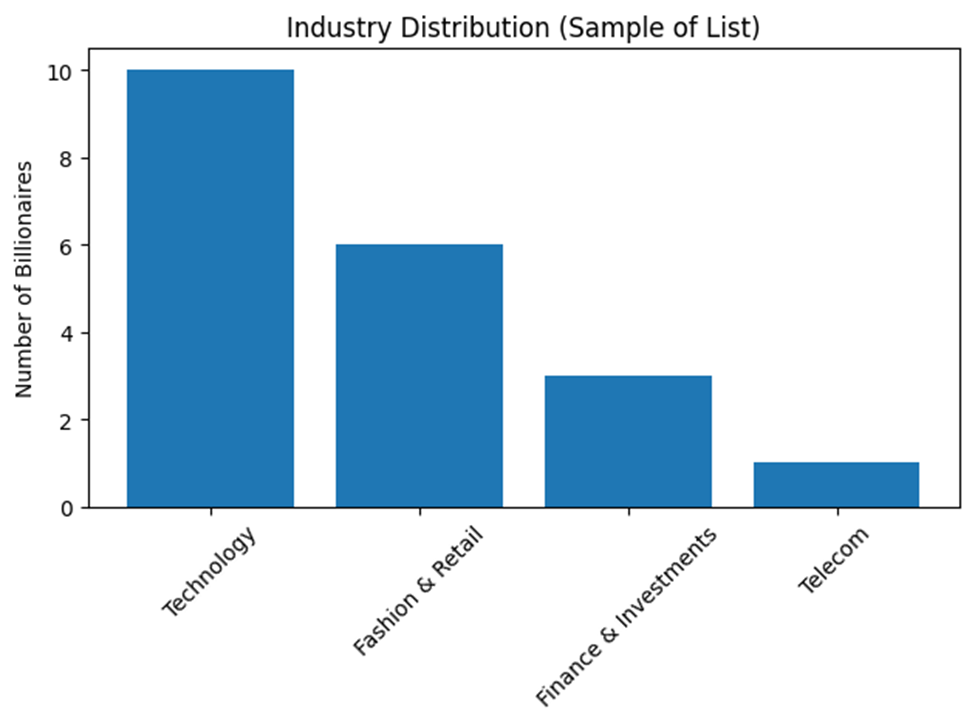
Technology Built Platforms; Marketing Built Adoption
Consider the technology sector which is one of the largest sources of billionaire wealth.
Companies founded by entrepreneurs such as Larry Page, Sergey Brin and Jensen Huang transformed computing, search and artificial intelligence. While their success began with technological innovation, technological innovation alone rarely guarantees global adoption.
Platforms grow because people discover them, talk about them and eventually depend on them. That discovery process is driven by marketing.
Amazon did not become a global marketplace purely because of logistics infrastructure. Its growth relied heavily on digital acquisition, recommendation systems and platform visibility.
Meta itself built one of the largest advertising infrastructures in history.
Technology companies may build the product, but marketing builds the audience that sustains it.
Retail and Luxury: Wealth Built on Perception
Retail billionaires offer another interesting example. Figures such as Amancio Ortega and Phil Knight built brands that influence global consumer culture.
Retail, more than most industries, depends heavily on perception.
Consumers do not simply buy clothing, accessories or footwear. They buy identity, lifestyle and aspiration.
These ideas are communicated through brand storytelling, advertising and cultural positioning.
In many ways, retail fortunes depend deeply on marketing.
Yet even here, the billionaires themselves are typically brand owners and operators rather than marketing specialists.
The brand becomes their asset. Marketing becomes the mechanism through which that asset grows.
Finance Built Capital; Marketing Built Trust
The financial sector produces a large number of billionaires as well. Investors like Ray Dalio and hedge fund leaders such as Ken Griffin built fortunes through investment strategy and capital allocation.
Finance operates on a different form of currency, which is trust. Investment platforms, financial services and asset management firms depend heavily on reputation.
In modern markets, that reputation is often communicated digitally through content, analysis, commentary and public visibility.
Marketing in finance may appear subtle, but it remains essential.
Capital flows more easily toward institutions that people recognise and trust.
The Billionaire Blind Spot
Across hundreds of billionaires and dozens of industries, one observation continues to repeat itself. The founders are engineers, financiers, industrialists or entrepreneurs. They are rarely marketers.
This does not mean marketing lacks influence. In fact, it suggests something more interesting.
Marketing rarely creates the product, but it determines how far that product travels and is therefore, integral to the billionaire journey.
The Real Currency of the Digital Economy
In the modern business landscape, visibility has become one of the most valuable assets a company can possess. Products compete not only on quality but on attention. Consumers discover brands through search results, social media feeds, online communities and digital recommendations.
All of these pathways are shaped by marketing. A company may create an excellent product. But if people never hear about it, adoption remains limited. Marketing transforms innovation into recognition. Recognition, in turn, enables scale.
Why Marketing Rarely Produces Billionaires
The absence of marketing billionaires does not mean the industry lacks value. Instead, it reflects the role marketing plays in business ecosystems.
Marketing functions as an amplifier. It accelerates growth for products, platforms and services created elsewhere.
Think of it as the infrastructure of visibility. Infrastructure rarely becomes the headline story, but it quietly enables everything else to operate.
The Lesson for Modern Businesses
The billionaire list highlights a useful lesson about growth. Successful companies tend to combine two elements: The first is innovation. The second is distribution. Innovation produces the idea or product. Distribution ensures that the idea reaches millions of people.
In today’s digital economy, distribution increasingly depends on marketing systems. Those systems shape how audiences discover, trust and engage with brands.
Social Buzz’s Perspective on the Billionaire Economy
At Social Buzz, we find these patterns particularly interesting.
The billionaire list demonstrates that wealth often begins with invention, capital or infrastructure. Yet scale usually requires something more subtle: attention.
Marketing manages attention. It translates complex ideas into stories people understand and share.
Understanding this process allows brands to move beyond visibility alone and build lasting influence because the most successful companies do not simply create products, but audiences. These audiences are built through communication.
If you enjoy real-time analyses of business environments, follow Social Buzz for more such insights.
FAQs
1. Why are there very few marketing billionaires?
Marketing generally functions as a service or growth engine rather than a primary asset. Most billionaire fortunes are created through products, technology platforms or financial investments.
2. Do successful companies still depend on marketing?
Yes. Even the largest technology, retail and finance companies invest heavily in marketing to acquire customers, build trust and maintain brand visibility.
3. Why is marketing important for technology companies?
Technology companies need user adoption to succeed. Marketing helps communicate the value of the product and encourages large-scale usage.
4. Can marketing determine whether a product succeeds?
In many cases, yes. A strong product without visibility may struggle, while effective marketing can accelerate awareness and adoption.
5. What is the main business lesson from the billionaire list?
Innovation creates opportunity, but distribution creates scale. Marketing plays a major role in enabling that distribution.
Author




I like how you explained marketing as an amplifier rather than the starting point. Many successful companies clearly depend on strong branding and attention to grow!
Millionaire mindset needs careful observation and then tweaks!
What an interesting perspective! I really enjoyed seeing things from another point of view, being a marketer myself!
Glad to offer a new perspective!
This is nice tip. I just realized now that this is true based on real life scenarios. We don’t really see billionaires working for their life.
They have the luxury to own their time!
This is such an insightful post. I have never looked at marketing like this before. Definitely bookmarking this.
Yayy! Glad to provide value
Marketing is such a crucial factor in having a successful business. Thank you for all the eye-opening insights about this topic.
I am glad you find it useful!
I’ve never thought much about it, but indeed there are few marketing based billionaires out there. That being said, I think figures like Elon Musk have crossed over from the more technical side to being the ‘face’ aka the marketing of brand. Perhaps we can say they have dual roles!
Technology offers convenience, scalability and that is why, Technology has been an enabler in making billionaires!
Interesting observation and you answered your own question.
Great wealth often comes from owning/controlling the supply/demand line, having an innovative product that hits all the distribution channels, and developing an effective marketing strategy. This is why MLM often dies on the vine once the top tier make their money. Lol! Okay, I went off topic here, but you get the drift. No product, limited future unless one is trading fantasies.
hmm that is indeed a very good observation!
Many billionaire companies solve real problems and grow through innovation. It feels practical. Focusing on gaps in the market and building useful solutions can lead to success and steady growth.