
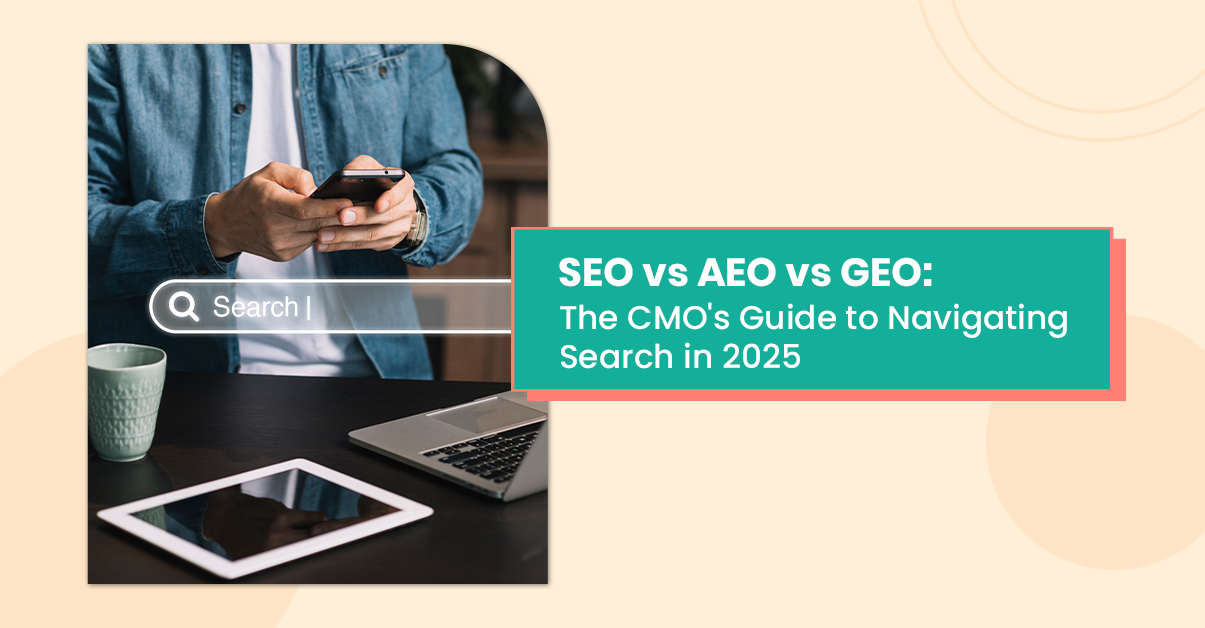
SEO vs AEO vs GEO: The CMO’s Guide to Navigating Search in 2025

Remember when getting your website to rank #1 on Google felt like winning the lottery? Those days aren’t completely gone, but something fundamental has shifted. Imagine spending months climbing to the top spot, only to discover that 60% of searchers never actually click on anything—not even you.
Welcome to 2025, where the search game has three players instead of one: SEO (the veteran you know), AEO (Answer Engine Optimization), and GEO (Generative Engine Optimization). If you’re a CMO trying to make sense of these acronyms while your CEO asks why website traffic isn’t growing despite “great rankings,” this guide is for you.
Let me walk you through what’s actually happening in search right now—with real numbers, real implications, and actionable insights.
The Great Search Shift: What’s Really Happening
Picture this: You search “What’s the best CRM for small businesses?” on Google. Instead of seeing a list of blue links, you get an AI-generated summary at the top of the page that answers your question completely. You read it, get what you need, and close the tab.
The website that provided that information? They just lost a visitor.
This isn’t a hypothetical scenario—it’s happening right now, at scale.
The Numbers Tell the Story
According to Search Engine Land’s Q1 2025 report, only 40.3% of U.S. Google searchers clicked on an organic result in March 2025, down from 44.2% the year before. Even more striking, zero-click searches (where users get their answer without clicking anything) increased from 24.4% to 27.2% year-over-year.
But here’s where it gets really interesting: Similarweb’s July 2025 report found that zero-click searches surged from 56% to 69% in just one year—a 13-point jump that coincided with Google’s wider rollout of AI Overviews.
Think about that for a moment. Nearly 7 out of every 10 searches now end without anyone clicking on anything.
| Metric | March 2024 | March 2025 | Change |
|---|---|---|---|
| Organic Click Rate (US) | 44.2% | 40.3% | -8.8% |
| Zero-Click Searches (US) | 24.4% | 27.2% | +11.5% |
| Zero-Click (Similarweb Study) | 56% | 69% | +23.2% |
Sources: Search Engine Land, Similarweb
What This Means for Your Business (An Everyday Example)
Let’s make this relatable. Imagine you own a coffee shop chain, and you’ve invested heavily in content marketing. Your blog post “How to Make Cold Brew at Home” ranks #1 on Google. Success, right?
Not anymore.
Now, when someone searches that phrase, Google’s AI Overview synthesizes information from your article (and others) and presents a complete guide right on the search page. The user gets their answer, makes their cold brew, and never visits your site. You spent resources creating that content, but you don’t get the website visit, the ad impression, or the chance to convert them into a customer.
This is the new reality for businesses of every size.
Understanding the Three Search Strategies
Traditional SEO: Still Important, But No Longer Enough
What it is: Search Engine Optimization—the practice of improving your website’s ranking in search results through keywords, backlinks, quality content, and technical optimization.
The current state: The #1 organic result on Google gets 39.8% of all clicks, or 42.9% if it’s also a featured snippet. That sounds good until you realize that organic CTRs for the top position dropped 32% from 2024 to 2025, falling from 28% to just 19% after AI Overviews became more prevalent.
Real-world impact: Organic click-through rates for informational queries featuring Google AI Overviews fell 61% since mid-2024, according to Seer Interactive’s latest study.
When it still works best:
- Navigational searches (people looking for your brand specifically)
- Transactional queries (people ready to buy)
- Local searches (“near me” queries)
AEO (Answer Engine Optimization): The Quick-Win Strategy
What it is: Optimizing your content to be the answer that appears directly in search results—featured snippets, People Also Ask boxes, knowledge panels, and voice assistant responses.
Think of AEO as optimizing for “Position 0″—the answer box that appears before the traditional #1 ranking.
Why it matters: According to Statista, around 15 million US adults relied on generative AI as their primary online search method in 2024, and that number is expected to triple by 2028. Meanwhile, voice commerce is projected to reach $80 billion annually, and an estimated 153.5 million Americans—almost half the population—are expected to use voice assistants by 2025.
The advantage: Organizations implementing comprehensive AEO strategies report capturing an average of 23% more total search visibility compared to those focusing exclusively on traditional search engines. Even better, companies that established dedicated AEO strategies in early 2024 report capturing 3.4x more answer engine traffic compared to competitors who delayed implementation.
How AEO Works in Practice
Let’s say you’re a financial services company. Instead of just targeting “retirement planning tips,” you structure your content to directly answer questions like:
- “What is the 4% retirement rule?”
- “How much should I save for retirement by age 40?”
- “When can I start withdrawing from my 401 (k) without penalty?”
You write concise, 40-60-word answers at the beginning of each section, use FAQ schema markup, and structure your content with clear question-based headers.
The result? Your content appears in featured snippets, voice search results, and People Also Ask boxes—getting visibility even when users don’t click through to your site.
GEO (Generative Engine Optimization): The Future is Here
What it is: Optimizing your content to be cited and referenced by AI chatbots and generative engines like ChatGPT, Perplexity, Claude, Google’s Gemini, and Bing’s Copilot.
This is where things get really different. With GEO, success isn’t measured by rankings or clicks—it’s measured by citations and mentions in AI-generated responses.
The explosive growth: 31% of marketers now use generative AI extensively in SEO, with another 25% using it partially—totaling about 56% adoption. More importantly, 75% of digital agencies have launched GEO services in 2025.
And the platforms themselves are growing like crazy:
| Platform | Monthly Active Users (2025) | Growth Rate |
|---|---|---|
| ChatGPT | ~400 million | Dominant leader |
| Perplexity | 22 million | 66% YoY |
| Gemini | ~400 million | Rapid growth |
| Claude | 20-35 million | Steady growth |
Source: Views4You 2025 AI Tools Report
Why this matters for CMOs: Perplexity AI processes over 780 million monthly search queries, up from just 230 million in mid-2024—that’s more than tripling in under a year. ChatGPT alone has over 400 million weekly active users.
These aren’t niche platforms anymore. They’re mainstream search alternatives.
The Demographic Divide: Who’s Using What?
Here’s something that should make every CMO sit up: the people using AI search aren’t the same as traditional Google users.
According to WebFX, over 60% of Millennials and Gen Zers already use AI engines in their search routines. A 2025 Menlo Ventures survey reported that 61% of U.S. adults used AI to search for information within the past six months.
Think about that. If your target customer is under 40, there’s a better-than-even chance they’re already using ChatGPT or Perplexity to research your competitors.
The everyday impact: Imagine you sell B2B software. A 28-year-old product manager researching solutions for her company might start with ChatGPT: “What are the best project management tools for remote teams?” If your brand isn’t cited in that AI response, you’ve lost a potential customer before the evaluation even begins.
What Actually Works: Strategies for Each Approach
SEO: The Foundation
Still critical for:
- Brand searches
- Bottom-of-funnel keywords
- E-commerce product pages
- Local business visibility
Key focus areas:
- Technical SEO (site speed, mobile optimization)
- Quality backlinks from authoritative sites
- User experience and Core Web Vitals
- Traditional keyword optimization
AEO: The Quick Wins
Most effective for:
- “How to” content
- Definition queries
- Step-by-step guides
- FAQ content
Implementation tactics:
- Answer questions immediately: Pages using schema saw 58% higher visibility in AI snippets compared to non-schema pages in 2025
- Use structured data: Implement FAQPage, HowTo, and Article schema markup
- Write concisely: Featured snippets favor answers of 40-60 words
- Think voice-first: Voice searches typically use natural, question-like phrasing
Example structure:
Question: How much should I save for retirement?

Answer (first 50 words): Financial advisors typically recommend saving 10-15% of your pre-tax income for retirement. If you start at age 25, 10% is usually sufficient. Starting at 35? Aim for 15%. Starting at 45? You'll need to save 20% or more to catch up.

[Followed by detailed explanation...]
GEO: The Competitive Advantage
Most effective for:
- Thought leadership
- Industry expertise
- Research-backed content
- Comprehensive guides
Key strategies from the research:
A Princeton study found that the best combination of GEO methods—Fluency Optimization and Statistics Addition—outperformed any single strategy by more than 5.5%.
What this means in practice:
- Add statistics: Content with relevant data gets cited more often
- Include expert quotes: Adds authority signals
- Cite credible sources: Shows you’re well-researched
- Improve readability: Write at an 8th-grade level with a clear structure
- Update frequently: Most LLM citations occur within 2-3 days of publishing and can represent up to 2% of all citations in a niche, but this decays quickly to just 0.5% within 1-2 months
The Platform Differences: Where to Focus
Not all AI platforms work the same way. Here’s what matters:
ChatGPT
Prioritize structured summaries and TL;DR sections. GPT-4 favors high-E-E-A-T content (Experience, Expertise, Authority, Trust) with named authors and original research.
Perplexity
Prefers transparent citations and a clear editorial structure. Include original statistics and structured comparisons, and optimize URLs with clean slugs.
Google Gemini
Cross-benefits with Google’s AI Overviews and AI Mode, so traditional SEO fundamentals still apply alongside answer-focused content.
The Business Impact: What CMOs Need to Know
Let’s talk about what really matters: business results.
Traffic vs. Trust
Here’s the counterintuitive part: NerdWallet reported a 35% growth in revenue despite a 20% decrease in site traffic by ensuring its content and brand expertise still reached consumers through snippets and other channels.
This is the new math of search marketing. Fewer clicks don’t necessarily mean fewer customers—if you’re visible in the right places.
Early Mover Advantage
Organizations that have established comprehensive AEO strategies now will be well-positioned to adapt to these developments as the answer engine ecosystem continues to evolve. And remember: early adopters capture 3.4x more answer engine traffic than late movers.
Brand Visibility Wins
Profound’s 2025 AI visibility data shows that smaller brands can achieve disproportionate representation in LLM answers, gaining consideration where they previously struggled to get the same share of voice through traditional marketing.
Translation: If you’re not the biggest player in your space, GEO and AEO might be your best chance to compete with larger competitors.
How to Think About Budget Allocation
Here’s a framework based on current industry trends:
2025 Baseline
- Traditional SEO: 45-50%
- AEO: 25-30%
- GEO: 20-25%
2026-2027 Projection
- Traditional SEO: 30-35%
- AEO: 25-30%
- GEO: 35-40%
Why the shift? Gartner forecasts that traditional web-search volume will fall 25% by 2026 as users shift to AI chat interfaces.
Check out our blog post on AEO vs SEO
The Action Plan: What to Do Tomorrow
Immediate (Week 1-2)
- Audit your content for question-based queries
- Add the FAQ schema to your most important pages
- Rewrite the intro paragraphs to directly answer the primary question
- Set up tracking for featured snippets and AI citations
Short-term (Month 1-3)
- Create 20-30 pieces of question-focused content
- Implement comprehensive, structured data
- Start monitoring mentions in ChatGPT and Perplexity
- Test content in multiple AI platforms
Long-term (Quarter 2+)
- Build a dedicated AEO/GEO content strategy
- Train content creators on answer-first writing
- Develop authority through consistent citation-worthy content
- Track visibility metrics beyond just clicks
The Bottom Line
If you’re reading this as a CMO, here’s what you need to know:
Traditional SEO isn’t dead—it’s just not enough anymore. While organic clicks are declining, total traffic from Google hasn’t collapsed. The traffic is just being distributed differently.
AEO is the quick win—you can start seeing results in weeks instead of months, and capture visibility even in zero-click scenarios.
GEO is the future—and that future is arriving faster than most people realize. U.S. searches for “Answer Engine Optimization” surged by more than 240% since January 2024, showing this isn’t a fringe concept anymore.
The brands winning in 2025 aren’t choosing between SEO, AEO, and GEO—they’re doing all three strategically. Because here’s the reality: your potential customers are searching in all three ways, often in the same buying journey.
The question isn’t whether to adapt. It’s how quickly you can make the shift before your competitors do.
A Final Thought
Remember when everyone said “mobile-first” was just a buzzword? Or when “voice search optimization” seemed like overkill? The companies that acted early on those trends gained years of competitive advantage.
This is one of those moments.
The search landscape is fundamentally changing—not next year, not next quarter, but right now. The data is clear, the tools exist, and your audience is already there.
The only question is: will you be?
About the Author: Ambuj is a branding specialist at Social Buzz, a digital marketing agency that helps businesses navigate the evolving search landscape. Have questions about implementing AEO or GEO for your business? Connect with our team at Social Buzz.
Sources & Further Reading
All statistics in this article have been carefully sourced from industry research published in 2025. Key sources include:
- Search Engine Land – Quarterly search behavior reports and AI Overview studies
- First Page Sage – Google CTR studies and generative AI chatbot market share data
- Backlinko – Organic CTR analysis across 4 million search results
- GrowthSRC Media – 200K keyword study on organic CTR by position
- SparkToro & Similarweb – Zero-click search studies
- Seer Interactive – AI Overview impact on CTR research
- CXL, Surferseo, and Void.ma – Comprehensive AEO implementation guides
- Princeton University – GEO effectiveness research (arXiv paper)
- Amsive, Junhammer, and Superlines – AEO/GEO strategy research
- DemandSage, Seoprofy, and Business of Apps – Perplexity AI statistics
- Views4You – 2025 AI Tools usage statistics
- AIMultiple, Writesonic, and Marketing LTB – GEO best practices and statistics
For transparency: Some of the most specific statistics (such as exact investment vs. return percentages) mentioned in earlier discussions could not be independently verified through public sources and have been excluded from this article. All included statistics are traceable to published research or industry reports from 2025.
FAQ’s Section
1) What is the difference between SEO, AEO, and GEO?
SEO focuses on improving search rankings for clicks, AEO optimizes content for direct answers in featured snippets and voice search, while GEO ensures content gets cited in AI-generated responses.
2) Why are zero-click searches impacting traditional SEO?
Zero-click searches have risen to 69% as users get answers directly from AI overviews without clicking through, reducing organic click-through rates by up to 61% for informational queries.
3) How does AEO provide quick wins over traditional SEO?
AEO delivers quick wins by structuring content for Position 0 like featured snippets, and People Also Ask boxes using 40-60 word answers, FAQ schema, and question-based headers, boosting visibility 23% on average.
4) What makes GEO a competitive advantage in AI search?
GEO excels in thought leadership by creating comprehensive, research-backed content with statistics and fluent language that AI systems cite as sources, outperforming single strategies by over 5.5%.
5) Which content types work best for AEO strategies?
AEO works best for how-to guides, FAQs, definitions, and step-by-step content optimized with structured data like HowTo schema and concise answers that match voice search phrasing.
6) When should CMOs prioritize SEO versus AEO or GEO?
Prioritize SEO for brand searches, transactional keywords, e-commerce, and local visibility; use AEO for informational queries and GEO for building authority through citation-worthy expert content.
7) How can businesses implement a combined SEO-AEO-GEO strategy?
Implement by maintaining technical SEO foundations, adding AEO schema for snippets, and developing GEO through authoritative guides, tracking visibility beyond clicks for AI traffic.
8) What metrics show the shift from SEO to AEO and GEO?
Metrics like organic click rate dropping 8.8% to 40.3%, zero-click searches up 23.2% to 69%, and 3.4x more answer traffic for early AEO adopters highlight the need for AEO/GEO.
Authors





Comment (01)